

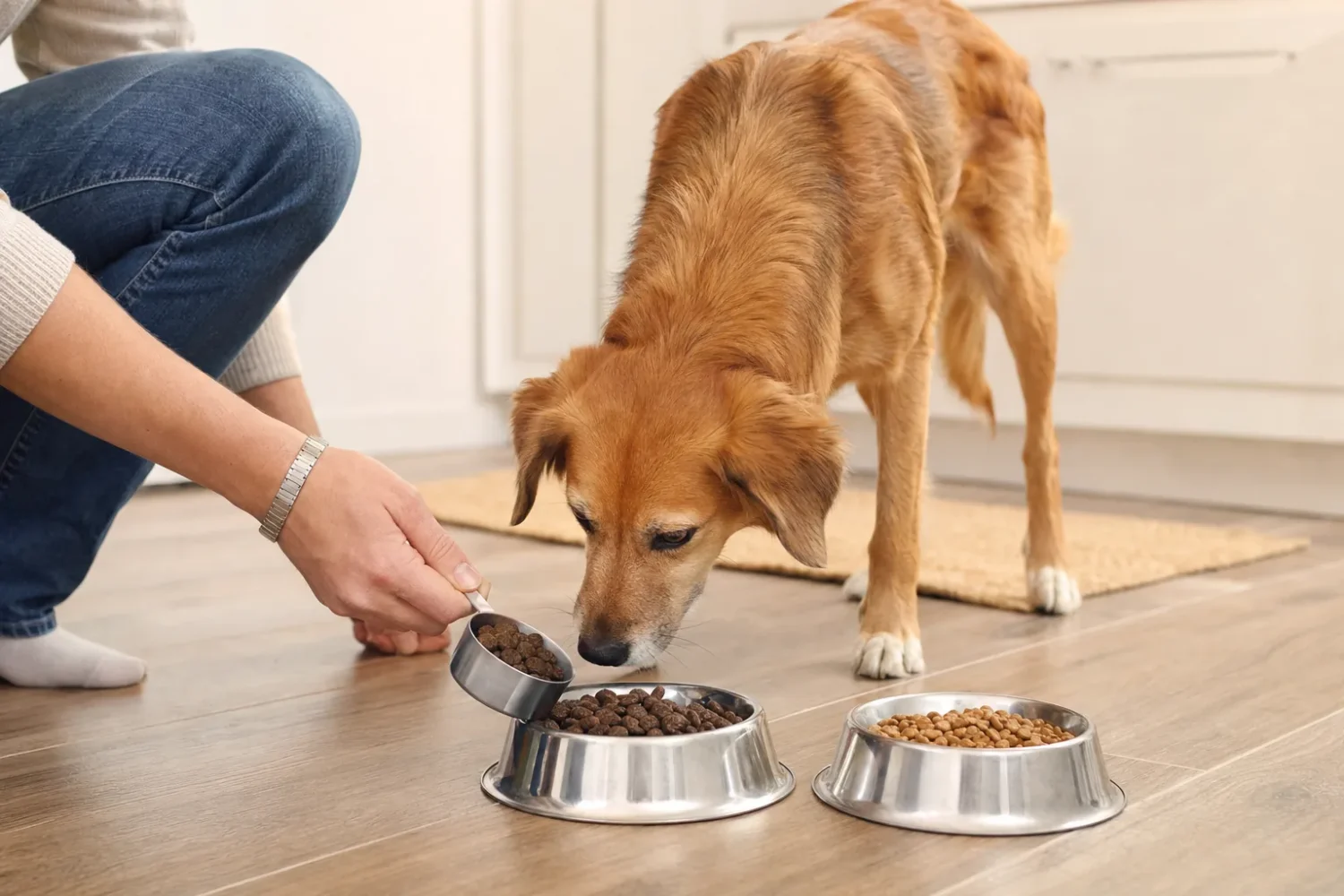
Transition your dog to the new kibble gradually over roughly 7 days: a quarter of the new food for the first two days, then half and half, then three quarters, and only the new food from day 7 onwards. Give puppies, senior dogs, and dogs with sensitive digestions more time—easily 10–14 days.
In a nutshell
- Digestion takes several days to adjust to a new recipe, which is why the foods are mixed.
- Percentages are calculated from each food's daily portion; the new food is not added on top.
- Slightly softer stools during the first few days are common. If it gets worse, take a step back.
- Do not introduce new treats during the transition.
- Stool consistency and your dog's well-being matter most, not the calendar.
Why transition to new food gradually?
Every food has a different composition: a different type of meat, a different proportion of fat and fibre. A dog's digestion is adjusted to what the dog eats. When their diet changes overnight, it doesn't have time to adapt, often leading to loose stools, flatulence, or loss of appetite. A gradual transition gives the digestive system time, and you will see whether the new food suits your dog.
A gradual transition is always worthwhile: when switching brands, changing meat types, or transitioning from puppy food to adult food.
What does the day-by-day transition plan look like?
Basic 7-day plan
For a healthy adult dog that usually handles changes without issues.
| Day | Original food | New food | What to look for |
|---|---|---|---|
| Days 1–2 | 75 % | 25 % | appetite |
| Days 3–4 | 50 % | 50 % | stool, wind |
| Days 5–6 | 25 % | 75 % | stool, energy levels |
| from day 7 | – | 100 % | stool stabilises |
Slow 14-day plan
For puppies, older dogs, dogs with sensitive digestion, and during a major dietary change, such as switching from a completely different type of food.
| Day | Original food | New food |
|---|---|---|
| Days 1–3 | 90 % | 10 % |
| Days 4–6 | 75 % | 25 % |
| Days 7–9 | 50 % | 50 % |
| Days 10–12 | 25 % | 75 % |
| from day 13 | – | 100 % |
Gradually mixing the foods over the course of about a week—or longer for sensitive dogs—is also recommended by the veterinary nutrition service at Tufts University. If everything is fine, stick to the plan. If not, stay on the same step a bit longer.
How to mix the foods in practice?
- Find out the daily portion for both foods. Foods often have different energy densities, meaning their daily portions in grams will differ. You can find the portion size for the new food on the packaging; for tailor-made dog food, you will receive it when you build the food.
- Calculate the percentages from each portion separately. On the first day, give three quarters of the daily portion of the original food and one quarter of the daily portion of the new food. Do not add the new food on top of a full meal.
- Mix them into every meal. Put both foods into one bowl and mix them together. Do not alternate between one in the morning and the other in the evening.
- Weigh the food. Kitchen scales are more accurate than a measuring cup.
- One change at a time. Do not introduce new treats during the transition.
- Same routine. Feed at the same times and in the same spot.
What to do if things do not go smoothly?
| What is happening | What to do |
|---|---|
| Stool is slightly softer, but the dog is fine | normal, stay on the same step for 2–3 days longer |
| Stool is runny or more frequent | go back one step and then proceed more slowly |
| The dog has more wind | slow down the transition, check the portion size and make sure the dog is not gulping food |
| The dog picks out only the new kibble and leaves the old | if the stool is normal, you can transition more quickly |
| The dog refuses the new kibble | start with a smaller proportion, mix well, and do not leave the bowl out all day |
If your dog refuses to eat at all during the transition, our article will help What to do when your dog refuses to eat. We discuss digestive gas caused by dietary changes in our article Flatulence and bloating in dogs.
How to proceed in special situations?
Puppy arriving in a new home
Feed what the puppy was used to from the breeder for the first 2–3 days, and only then start the slow schedule. You can find the number of meals per day by age in our article Feeding puppies from 8 weeks.
From puppy food to adult food
Switching depends on the breed and happens once the dog reaches adult weight, usually around 12 months. The standard 7-day schedule is sufficient.
Senior dogs or dogs with sensitive digestion
Choose a slow plan and feel free to extend each step.
Veterinary food
If your dog is on food recommended by a vet, always discuss any change with them first.
Original food ran out
If you have nothing left to mix with, divide the daily portion of the new food into 2–3 smaller meals over the first few days and monitor the stool.
From canned food or cooked meals to kibble
The texture and the water content of the meal also change. Opt for a slow transition schedule and make sure your dog always has plenty of fresh water available.
How long does it take to know if the food suits your dog?
Stool usually settles within a few days once the transition is complete. Assess whether the food suits your dog and tastes good long-term only after several weeks. In the meantime, avoid switching foods unnecessarily, as every new change restarts the transition process from scratch.
When to consult a vet?
Stop the transition and consult your vet if issues persist for more than a day or worsen, if your dog vomits repeatedly, is lethargic, or refuses water. The same applies if tummy issues return every time you increase the proportion of the new food.
Transitioning to kibble made with fresh meat
Rawbark makes tailor-made dog food using fresh meat from Czech farms. When you build kibble in our configurator, you will also get their daily portion, so you know exactly what to calculate the transition percentages from. Each recipe features just a single type of meat, so if a particular meat does not suit your dog, it is easy to switch. You can find more about our ingredients and production on the page Tailor-made dog food.
Frequently Asked Questions
How long does transitioning to new kibble take?
For a healthy adult dog, it usually takes 7 days: 25 % new food for the first two days, then 50 %, then 75 %, and 100 % from day seven onwards. Puppies, senior dogs, and dogs with sensitive digestion need 10–14 days. If their stool softens or worsens, stay on the current step longer or take a step back.
Can I switch my dog to a new food overnight?
Some dogs cope fine, but the risk of loose stool and gas is higher. A gradual transition takes only a week and lets the digestive system adapt in the meantime. If you have run out of the original food, divide the daily portion of the new food into 2–3 smaller meals over the first few days and keep an eye on their stool.
Is softer stool normal after changing food?
Slightly softer stool during the first days of transition is normal. Stay on the current step for a few days longer, or take a step back and proceed more slowly. If the trouble lasts longer than a day and worsens, or if your dog is vomiting or lethargic, stop the transition and consult your vet.
Should I mix the foods, or alternate them?
Mix them. Put both foods into each portion according to the schedule ratio and mix them together. Alternating—such as giving one food in the morning and the other in the evening—is not recommended. Calculate percentages from the daily portion of each food separately; do not add the new food as an extra serving.
What if my dog refuses to eat the new kibble?
Start with a smaller proportion of the new food and mix it thoroughly with the original. Leave the bowl down for only 15–20 minutes and do not offer treats between meals. Avoid switching food unnecessarily, as your dog needs time to get used to the new flavour. If they refuse food completely for more than a day or seem lethargic, consult your vet.
Do I need to transition gradually even between flavours of the same brand?
Yes, it is well worth it. A different type of meat means a different composition that digestion needs to get used to. For a dog that tolerates changes well, the standard 7-day plan is enough. For sensitive dogs and puppies, choose a slower schedule and feel free to extend each step by a day or two.
Sources
- Tufts Cummings School of Veterinary Medicine, Clinical Nutrition Service: vet.tufts.edu
- WSAVA Global Nutrition Guidelines: wsava.org
- FEDIAF Nutritional Guidelines: europeanpetfood.org
This article contains general feeding information. It does not replace the advice of a vet.
What will you learn in this article?
- Day-by-day transition schedule in percentages
- A slower plan for puppies and sensitive dogs
- How to mix two foods with the correct daily portion
- What to do if stool worsens
- When to consult a vet