

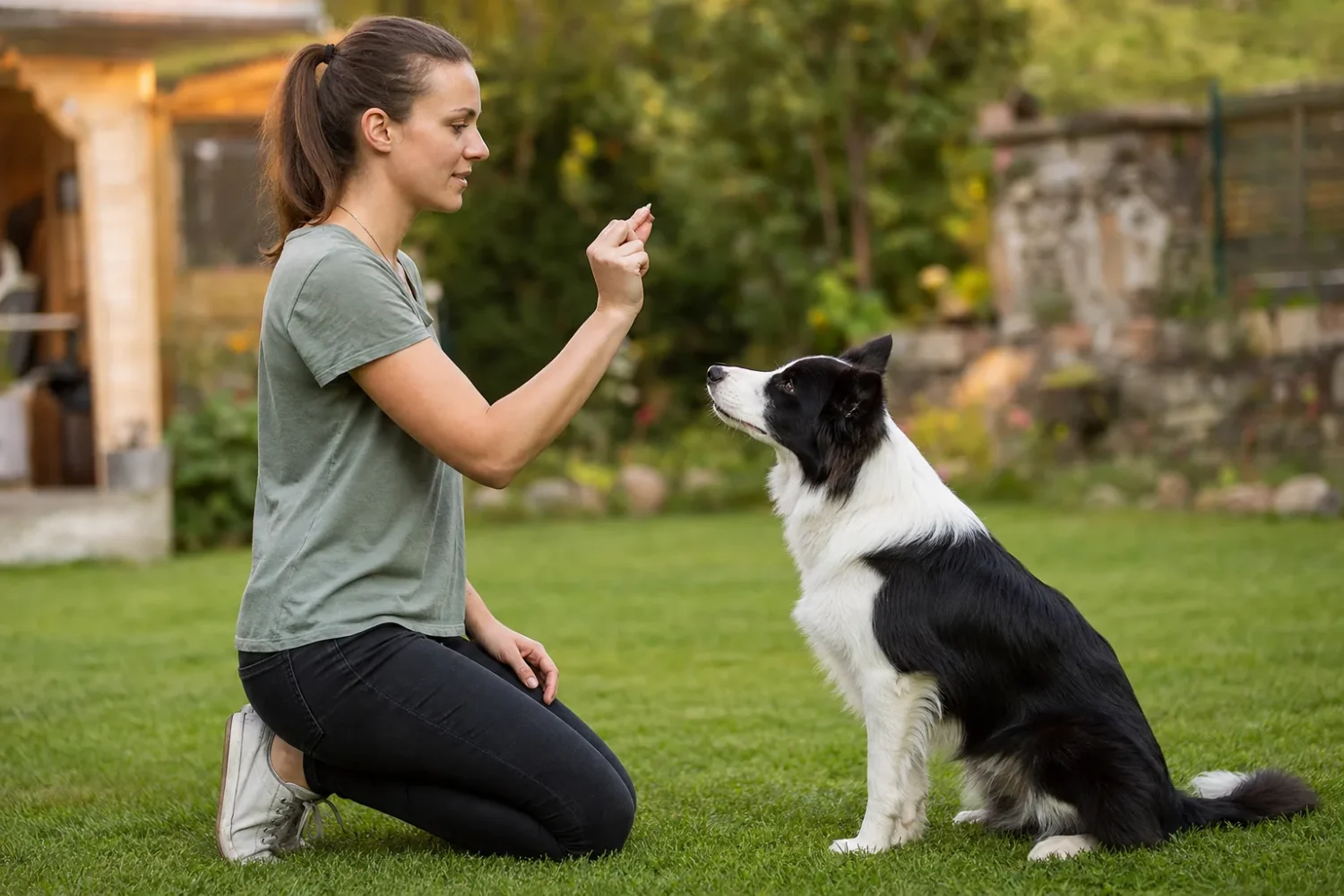
Start with sit, down, stay, come and loose-lead walking. Train in short sessions of a few minutes each and reward your dog the moment they do what you want with a small tasty treat or praise.
In a nutshell
- Five basic commands: sit, down, stay, come, heel (loose-lead walking).
- You can start training from the very first days at home, keeping it short and playful.
- The reward must come immediately, within a second of the desired behaviour.
- Keep sessions short and finish on a high note.
- Do not use punishment or tools that cause pain.
Which commands to teach your dog first?
| Command | Purpose | When to start |
|---|---|---|
| Sit | the foundation of self-control, e.g. before the bowl or near roads | from the first days at home |
| Down | settling in a restaurant, when visiting, in the car | once the dog has mastered sit |
| Stay | the dog waits in place until released | once the dog has mastered sit and down |
| Come (recall) | safety outdoors, the most important command of all | from the first days, at home and in the garden |
| Heel / loose lead | calm walks without pulling | from the first walks |
| Drop it | the dog gives up a toy or found item | during games with a toy |
Whether you use English or another language doesn't matter. What's essential is that the whole family uses the same words and the same hand signals.
How to train a dog effectively?
Reward-based training is best. The American Veterinary Society of Animal Behavior (AVSAB) states in its position statement that "evidence supports the use of reward-based methods for all canine training". British charities such as the RSPCA, Dogs Trust, and Blue Cross recommend the same.
- Keep it short. Sessions lasting just a few minutes, even multiple times a day. The RSPCA recommends short and regular training sessions.
- In a calm environment. Start at home without any distractions. Only practise outdoors afterwards.
- Immediate reward. Within a second of the correct behaviour, otherwise your dog won't understand what they're being rewarded for.
- The cue word comes second. Only add the verbal cue once the dog is performing the movement reliably, saying it right as they begin the action.
- End on a high note. The last repetition should always be a successful one.
- Progress gradually. Longer duration, greater distance, more distractions. Only one new element at a time.
How to teach a dog to sit?
- Stand in front of the dog and hold a treat right close to their nose.
- Slowly move it in an arc up and over their head. As the dog lifts their head, their bottom will naturally touch the floor.
- The moment they sit, praise them and give them the treat. The RSPCA emphasises rewarding immediately.
- Practise in short sessions.
- Once the dog sits reliably, say "sit" just as their bottom begins to lower.
- Gradually replace the food lure with just a hand gesture, and then with the verbal cue alone.
Do not push the dog into a sit with your hands. If you hold the treat too high, they'll jump; if you pull it too far back, they'll back away.
How to teach a dog to lie down?
- The dog is in a sit. Hold a treat right in front of their nose.
- Slowly guide it towards the floor between their front paws and then slightly forwards.
- As soon as they lie down, praise and reward them.
- Introduce the verbal cue "down" only once the dog is performing the action reliably.
How to teach a dog to stay and recall?
Stay: the dog is sitting or lying down. Say "stay", take one step backwards, return immediately and reward them on the spot. Gradually increase the duration, then the distance, and only then introduce distractions. End the exercise with a release word, such as "okay" or "free".
Recall / Come: start indoors at a short distance. Say their name and "come" in an upbeat, cheerful voice, take a step back and when the dog comes running, celebrate with their favourite treat. Never call them to do something unpleasant, and never scold them after they come to you. We'll cover recall in detail in a separate article.
How to teach a dog to walk to heel?
The key is making it rewarding for the dog to walk beside you and unrewarding to pull. Whenever the lead tightens, stop, and as soon as it slackens, carry on and reward them by your leg. You can find detailed instructions in the article Dog pulling on the lead.
What treats to use for rewards?
Whatever your dog genuinely loves. Usually it's food; for some dogs, it's a toy or play.
- Small pieces. The treat should be pea-sized so the dog doesn't get full and the lesson can continue.
- Match the difficulty. For new exercises and outdoors with distractions, use the tastiest options. At home, kibble from the daily portion is plenty.
- Count into the daily allowance. Count treats towards their daily food allowance, otherwise your dog will gain weight.
- Add praise. The word "good" or "yes" at the exact same moment as the reward will eventually become a reward in itself.
What training mistakes do we want to avoid?
- Overly long sessions. A tired dog makes mistakes and stops enjoying it.
- Repeating the command multiple times. "Sit, sit, sit" teaches the dog that the first word does not count.
- Delayed rewards. The dog associates it with whatever they were doing at the moment they received it.
- Punishment. Shouting, jerking the lead, or smacking the dog frightens them and slows down training.
- Painful tools. We do not recommend prong, choke, or electronic collars. AVSAB advises against using aversive methods in training.
When to ask for help?
If your dog is learning slowly, a course with a reward-based trainer will help. If fear, aggression, or a sudden change in behaviour appears, consult a dog behaviour specialist or a vet.
Pocket-friendly rewards
Na výcvik se hodí malé, voňavé odměny. Rawbark vyrábí kromě granulí na míru z čerstvého masa i meat treats, gently dried, such as Beef with spinach. The manufacturer recommends breaking them into smaller pieces during training. They are a complementary feed, so count them towards the daily portion. For easier exercises at home, kibble from the daily portion works well too.
Frequently Asked Questions
When should you start teaching a dog commands?
From their very first days at home. Puppies learn quickly and can handle short, playful sessions of a few minutes as early as eight weeks old. Start with their name, recall, and "sit". You can train an adult dog at any time—the process is the same: short, calm, and with a reward given immediately after the correct behaviour.
How do you teach a dog commands?
Lure the dog into the desired position with a treat—for example, by moving your hand above their head for "sit"—and reward them immediately. Add the verbal cue once they perform the movement reliably. Train in short, frequent sessions, start at home, and increase the difficulty gradually. Do not use punishment; rewards work better. Always practice each new command at home first.
How long does it take to teach a dog to sit?
Most dogs master the basics of "sit" within a few short sessions; for some, a single day is enough. For the command to work reliably outdoors and with distractions, it takes longer—usually weeks of repetition. Train in short sessions, multiple times a day, and gradually introduce environments with greater distractions. Patience helps, too.
Should commands be in Czech or in a foreign language?
The language does not matter. The dog learns the sound, not the meaning of the word. Some training grounds use commands in German or English because they are short. The important thing is that the whole family uses the same words and the same gestures, and that the commands do not get confused. Dogs often understand a hand gesture before a word.
How many treats should you give during training?
As many as you need, but in small, pea-sized pieces and counted towards the daily food allowance. For easy exercises at home, use kibble from the daily portion; for new things and outdoors, use something tastier. Once the dog knows the command, gradually reward only certain repetitions. Praise always remains.
Is an electronic collar suitable for training?
No, we do not recommend it. The American Veterinary Society of Animal Behavior (AVSAB) advises against using aversive methods in training and recommends reward-based training. The same applies to prong and choke collars. If you are struggling, reach out to a trainer who uses reward-based methods.
Sources
- AVSAB: Humane Dog Training Position Statement (2021): avsab.org
- RSPCA: Learn how to train your dog to sit: rspca.org.uk
- RSPCA: How to train your dog: rspca.org.uk
- Dogs Trust: How to stop your dog pulling on the lead: dogstrust.org.uk
This article contains general dog training advice.
What will you learn in this article?
- Which commands to teach first
- How to train so it works
- Sit, lie down, and stay step by step
- What to reward with
- Most common mistakes