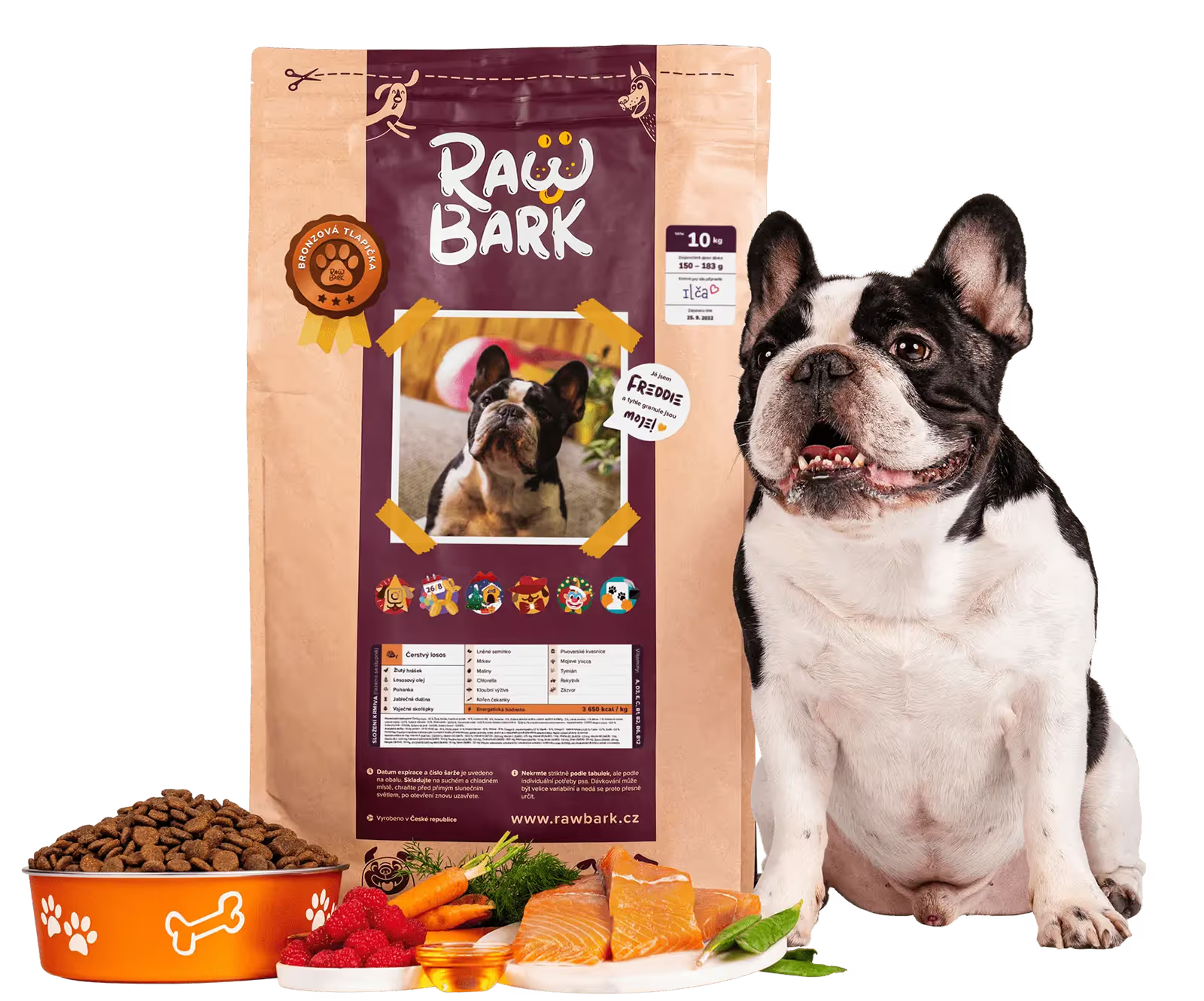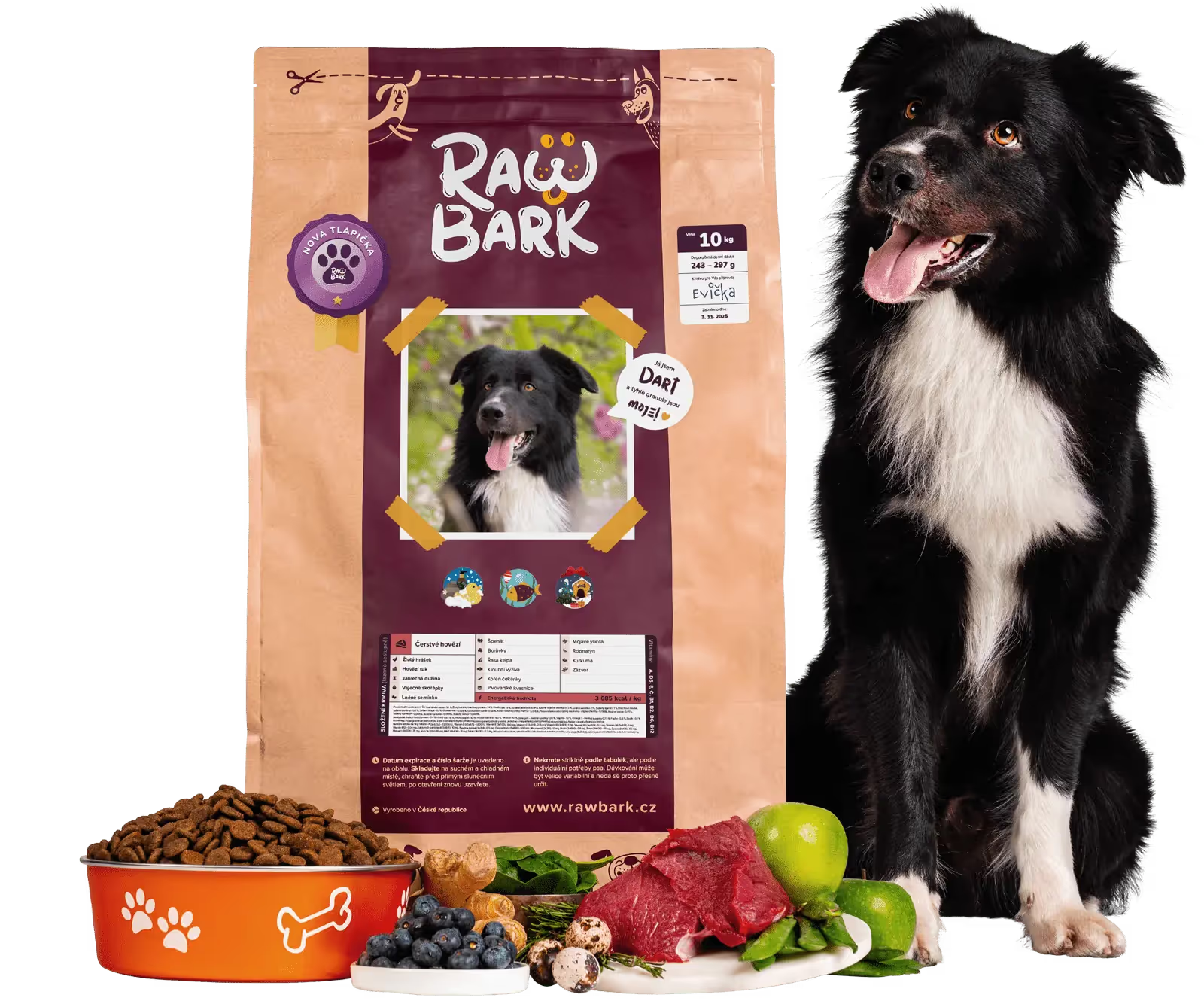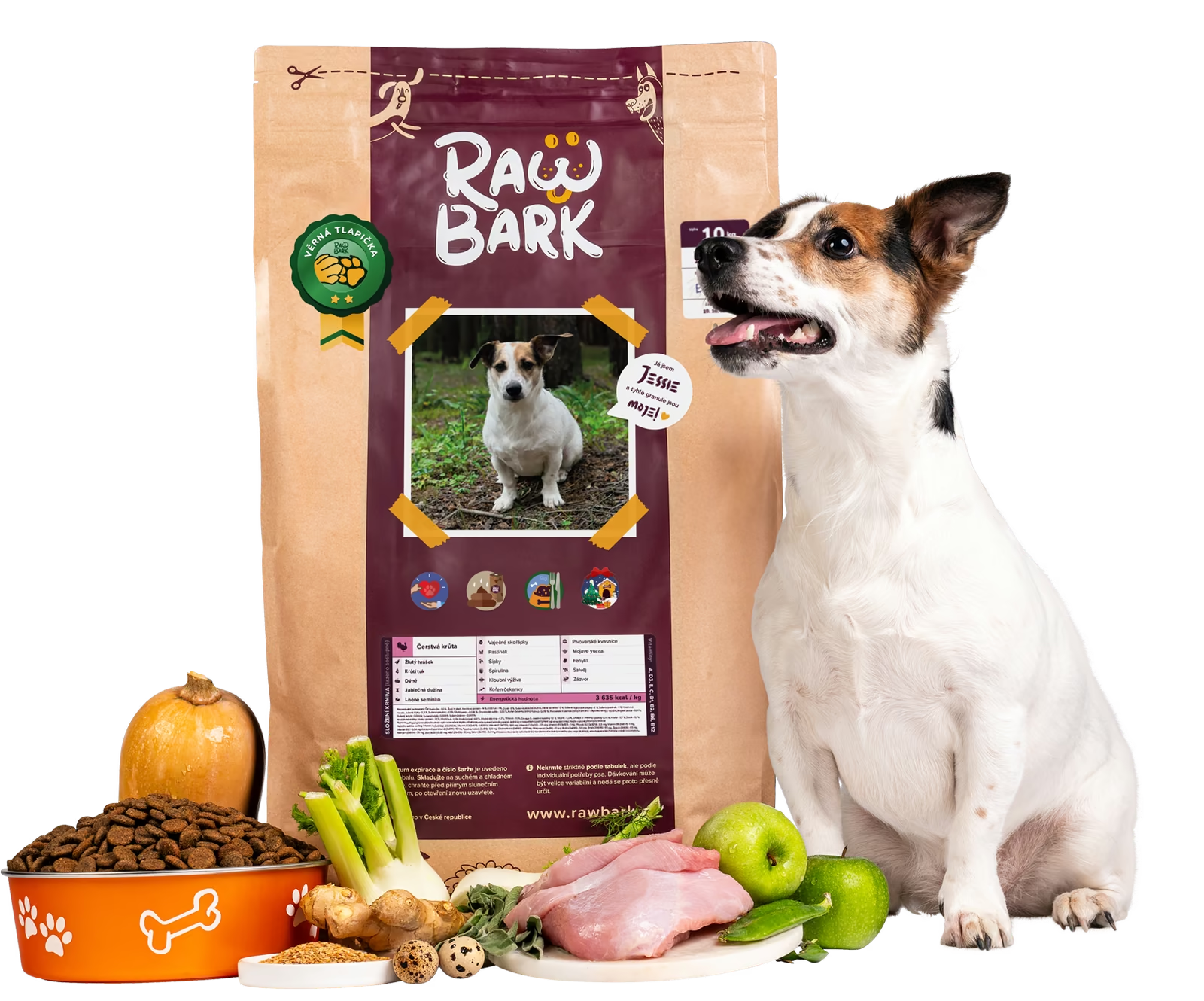


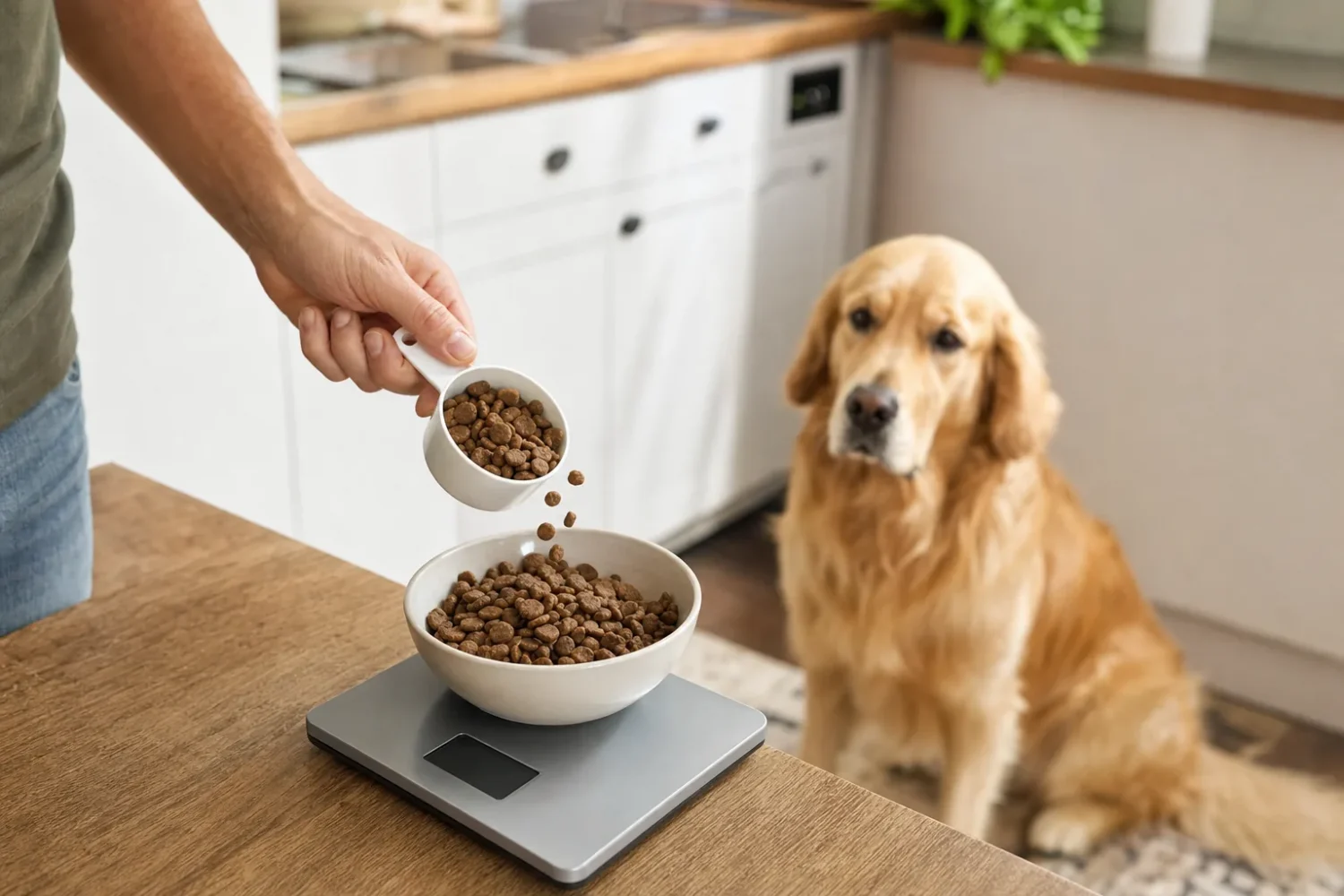
How much kibble a dog needs each day is mainly determined by their ideal weight, activity level, neuter status, and the caloric density of the specific food. You can find the baseline amount in the feeding guide on the packaging or calculate it from their daily energy requirements, then adjust it based on your dog's weight and body condition.
In a nutshell
- Two dogs of the same weight can require significantly different amounts.
- Daily energy is calculated from the dog's ideal weight and a coefficient based on neuter status and activity.
- You get grams by dividing the energy by the energy content of the food from the packaging.
- Every calculation is just a starting point. What matters is weighing your dog and monitoring their body condition after 2–4 weeks.
- Treats count towards the daily portion.
What affects how much a dog eats?
| Factor | Needs more | Needs less |
|---|---|---|
| Neutering status | intact dog | neutered dog |
| Activity | working and sporting dogs | calm dogs, short walks |
| Tendency to gain weight | – | dogs prone to gaining weight easily |
| Age | puppies (calculated separately) | older dogs who have slowed down |
| Food | food with lower energy (more grams) | food with higher energy (fewer grams) |
How to calculate the daily portion step by step?
The MSD Veterinary Manual calculates daily energy requirements from two numbers: resting energy requirement and a coefficient based on the type of dog.
- Ideal weight. Calculate based on the weight the dog should have. For an overweight or underweight dog, a vet will estimate it.
- Resting energy requirement (RER). RER = 70 × (ideal weight in kg)0,75. The result is in kilocalories (kcal) per day.
- Coefficient. Multiply the resting requirement by the coefficient from the table below.
- Conversion to grams. Divide the daily energy by the energy content of the food from the packaging.
- Check. Weigh your dog after 2–4 weeks and adjust the portion based on the results.
| Adult dog category | Factor |
|---|---|
| Neutered | 1.6 × RER |
| Not neutered | 1.8 × RER |
| Prone to weight gain | 1.4 × RER |
Highly active, working and sporting dogs may need significantly more. For them, as well as for dogs that need to lose or gain weight, adjust the daily portion with your vet.
How much energy does a dog need according to weight?
Values are calculated using the MSD Veterinary Manual formula and rounded to the nearest ten. Applies to a healthy adult dog in ideal body condition.
| Ideal weight | Prone to weight gain (1.4×) | Neutered (1.6×) | Intact (1.8×) |
|---|---|---|---|
| 2 kg | 160 kcal | 190 kcal | 210 kcal |
| 5 kg | 330 kcal | 370 kcal | 420 kcal |
| 8 kg | 470 kcal | 530 kcal | 600 kcal |
| 10 kg | 550 kcal | 630 kcal | 710 kcal |
| 15 kg | 750 kcal | 850 kcal | 960 kcal |
| 20 kg | 930 kcal | 1,060 kcal | 1,190 kcal |
| 25 kg | 1,100 kcal | 1,250 kcal | 1,410 kcal |
| 30 kg | 1,260 kcal | 1,440 kcal | 1,620 kcal |
| 40 kg | 1,560 kcal | 1,780 kcal | 2,000 kcal |
| 50 kg | 1,840 kcal | 2,110 kcal | 2,370 kcal |
According to the MSD Veterinary Manual, individual dogs commonly vary from the calculated figure by up to 30% in either direction. The table is therefore a starting point, not an exact portion.
How to convert calories into grams of kibble?
Find on the packaging the energy content of the food, usually in kcal per 100 g or per 1 kg. Then all it takes is one simple division:
grams per day = daily energy (kcal) ÷ food energy (kcal per 1 g)
Example: a neutered dog with an ideal weight of 15 kg needs about 850 kcal according to the table. If the food contains 380 kcal per 100 g, which is 3.8 kcal per 1 g, the daily portion works out to 850 ÷ 3.8 ≈ 225 g, split into two meals of roughly 110 g. The number 380 is just an example; always use the figure on your own food.
With Rawbark's tailor-made dog food, you don't need to calculate this – you get the daily portion when you build your dog's food.
How many meals should you divide the portion into?
Feed an adult dog at least twice a day. For large dogs with a deep chest, the MSD Veterinary Manual recommends several smaller meals instead of one large one, and rest after eating. Weigh kibble on kitchen scales, as measuring cups tend to be inaccurate.
Puppies are fed more frequently and their portion is calculated differently, see the article Feeding puppies from 8 weeks.
How do you know if the portion is right?
Weight alone is not enough, body shape is also important. The World Small Animal Veterinary Association (WSAVA) has a body condition score for this, in simple terms:
| What to check | Dog is underweight | Ideal condition | Dog is overweight |
|---|---|---|---|
| Ribs | visible even from a distance | easily felt under a thin layer of fat | can only be felt with pressure |
| Top view | prominent waist, protruding bones | noticeable waist behind ribs | no waistline |
| Side view | abdomen visibly tucked | abdomen slightly tucked | abdomen flat or drooping |
| What to do | increase the portion slightly | maintain the portion | reduce the portion slightly, limit treats |
Weigh your dog every 2–4 weeks on the same scales and at the same time of day. Adjust the portion in small steps, roughly by a tenth, and assess the result after another 2–4 weeks.
When to adjust the portion?
- After neutering, energy requirements usually decrease.
- With changes in activity, such as during winter or during the sporting season.
- With age, as older dogs slow down.
- When switching food, the new kibble will have a different energy density. Transition gradually; see How to transition to new kibble.
Do treats count towards the portion?
Yes. Treats, chews and table scraps contain calories. According to WSAVA, treats should make up less than 10 % of daily energy intake. If your dog receives more treats, reduce the amount of kibble slightly, or use kibble from their daily portion as rewards.
When to consult a vet?
Consult your vet if your dog is losing or gaining weight even though their diet and activity haven't changed, if they refuse to eat for more than a day or seem lethargic, or if they need to lose or gain weight. The calculations in this article apply to healthy adult dogs.
Tailor-made portion without any maths
Rawbark makes tailor-made kibble for dogs using fresh meat from Czech farms. In our configurator enter your dog's age, weight, condition, activity level, and any allergies, and you'll immediately see the recommended recipe and daily portion. You can then adjust your dog's details and recipe in your account under the My Pack section. Learn more about our kibble on the Tailor-made dog food.
Frequently Asked Questions
How much kibble per day should you give a 10 kg dog?
A neutered adult dog with an ideal weight of 10 kg needs roughly 630 kcal per day according to the MSD Veterinary Manual formula, while an intact dog needs about 710 kcal. How many grams that equals depends on the calorie density of the food: divide the calories by the energy value on the packaging. Then adjust the portion based on weigh-ins and your dog's body condition.
Should I follow the feeding guide on the packaging?
Yes, as a starting point. Feeding guides on the packaging are based on an average dog, so your dog might need slightly more or less. Weigh your dog after 2–4 weeks and check their ribs and waist. If they are gaining or losing weight, adjust the portion by roughly a tenth and continue to monitor them.
Should you feed a dog once or twice a day?
It is better to feed an adult dog at least twice a day. Smaller portions are easier on digestion and your dog won't go hungry for as long. For large, deep-chested dogs, the MSD Veterinary Manual recommends several smaller meals instead of one large one, followed by rest without running around after eating.
How much should you feed a neutered dog?
A neutered dog usually requires less energy than an unneutered one. The MSD Veterinary Manual formula calculates with a factor of 1.6 instead of 1.8, which is roughly a tenth less. Weigh your dog regularly after neutering, and if they start gaining weight, reduce the portion slightly and limit treats. Assess the changes after 2–4 weeks.
Do treats count towards the daily portion?
Yes. Treats, chews and table scraps contain calories. According to WSAVA, they should make up less than 10 % of daily energy intake. If your dog receives more treats, such as during training, reduce the amount of kibble slightly, or use kibble from their daily portion as rewards.
How often should you weigh your dog?
For an adult dog, weighing them every 2–4 weeks is enough, or more often when changing the portion or food. Weigh them on the same scales and at the same time of day. To weigh a small dog, weigh yourself holding them and subtract your own weight. Keep a record of the values.
Sources
- MSD Veterinary Manual: Nutritional Requirements of Small Animals: msdvetmanual.com
- MSD Veterinary Manual: Daily Maintenance Energy Requirements for Dogs and Cats: msdvetmanual.com
- MSD Veterinary Manual: Gastric Dilation and Volvulus in Small Animals: msdvetmanual.com
- WSAVA: Body Condition Score (dog): wsava.org
- WSAVA: Feeding treats to your dog (2025): wsava.org
This article contains general information about feeding healthy adult dogs. It does not replace veterinary advice.
What will you learn in this article?
- What affects how much a dog eats
- Step-by-step daily energy calculation
- Energy chart by dog weight
- How to convert calories into grams of kibble
- How to recognise and adjust the right portion