

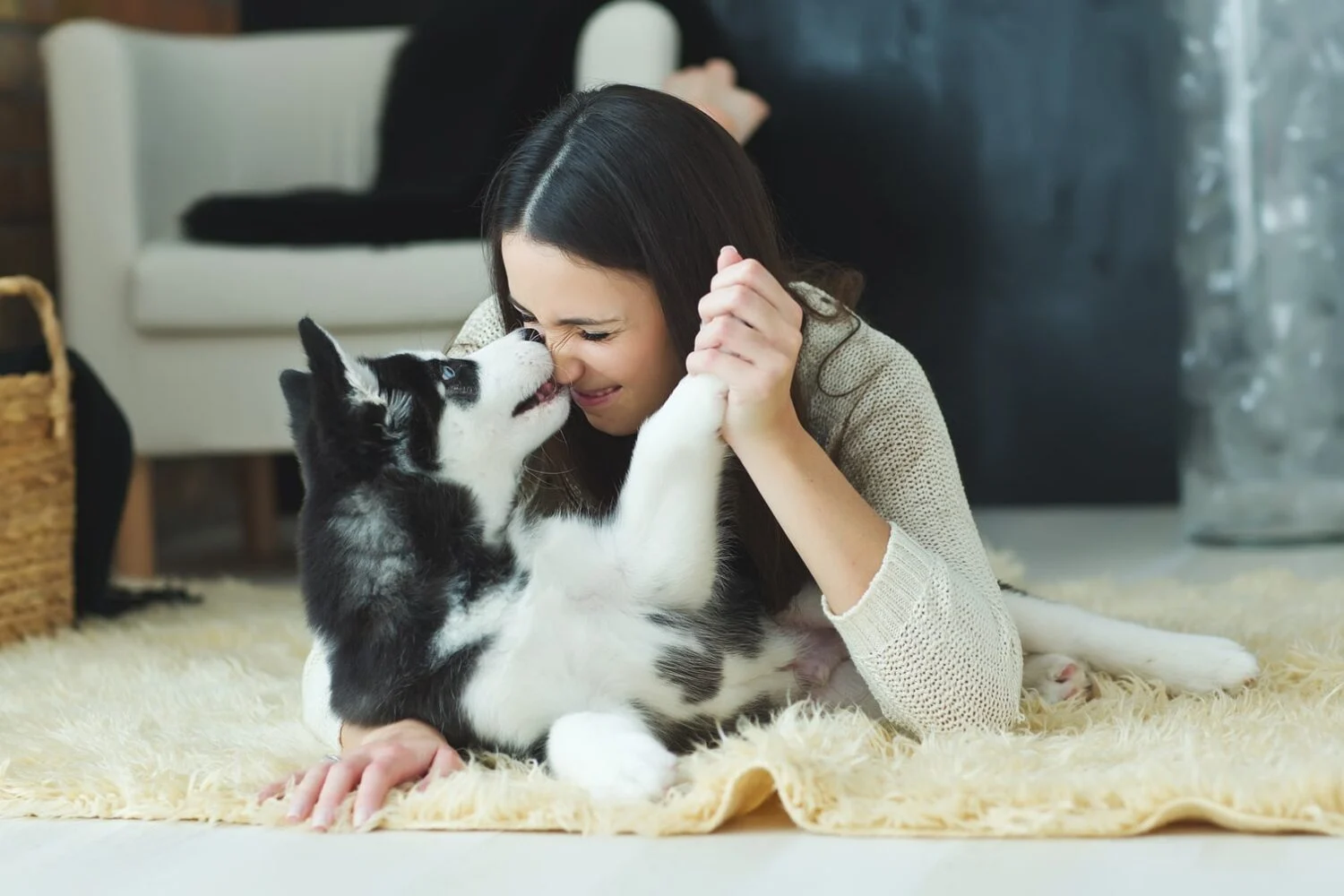
You've happily brought home a cute little puppy and can't wait to spend time together, cuddling and playing. At last you have a canine buddy at home and you're looking forward to all the moments you'll share. Unfortunately, expectations and reality differ, and you start to feel that you have a puppy at home that won't leave a single hand or foot without the marks of its adorable pointy little teeth.
Biting is considered natural behaviour in puppies. A puppy doesn't know how hard it can bite, because it isn't born with sensitive, gentle control of its jaws. It has to learn bite control gradually by playing with littermates of the same age, or it likes to practise its bite at home. Based on how we or other puppies react, it learns to control its biting. When a puppy bites, our response to its behaviour is very important. It won't work out on its own what's too much. Letting a puppy nibble on you without reacting is a sure way for it not to respect you.
Puppy school is a great opportunity for your dog to learn to control its biting. Give your puppy plenty of opportunities to play dog-style with other puppies and easy-going adult dogs. In a good interaction, several mutual nips happen within a short time, and the puppy quickly learns from them. The more it can let off steam with buddies of its own kind, the less it will need to bite you.

A puppy also practises its bite at home, and unfortunately the main target is either us or various objects within reach. By chewing, the puppy wants to keep itself busy and burn off the energy it has. The solution is to offer plenty of suitable things to chew, appropriate to the dog's age. Great options for puppies are various chews and chew bones, which accompany the puppy through teething and encourage chewing. Most of them are flavoured too, so if you have a dog that really loves to chew, this is a great choice. Another way to keep them busy is interesting games such as treat balls or dog puzzles, which will keep many a doggy brain occupied.

Teach your puppy to play with you and teach it games that are acceptable in human company. Show it ways of playing that suit both sides and become a source of endless fun. It's important to set a clear start and end to each game. You decide how long the game lasts and where the limits are. If, during play, your puppy behaves in a way you find unacceptable and a telling-off, explanation or redirecting to another activity doesn't help, correct it and end the game immediately.
Whenever your dog shows good behaviour don't forget to praise it– that's the only way it can understand what is and isn't right.
How to correct unwanted behaviour?
We all have our own way of reacting when a puppy bites. Every dog breed is very individual, and unfortunately there's no exact formula. What works for one may not work for another. Everyone will defend their own method, and you need to find the one that suits you and also works for your dog. So what should you do when a puppy bites? We asked experienced breeders this question, and below is a summary of some of their answers.

What you recommend most based on your experience:
Activities that let the puppy burn off excess energy. Keeping the puppy's mind busy, e.g. with obedience training (sit, down, place, come, …). Playing together, walks and plenty of opportunities to play with other dogs. Toys of different shapes and textures (choose according to the puppy's age). When it bites, cry out "ouch" as if in pain and give the dog something else it is allowed to bite. In a raised, firm voice say "no", "leave it", "enough" (whatever you use as a command to stop), end the game immediately and walk away.
The moment a puppy bites tell it off and stop moving = a motionless target is no fun.
Use a playpen during play that you can step out of in a split second, giving the puppy instant feedback on which kind of play is unacceptable.
Gently hold the puppy's muzzle closed, firmly say "enough", then send it to its place and end the game.
What will you learn in this article?
- What to give your puppy so it learns to control its biting
- How to keep your puppy busy and what's worth getting
- How to correct unwanted behaviour
- Practical experience and what breeders recommend